
Showing posts with label American history. Show all posts
Showing posts with label American history. Show all posts
Wednesday, December 7, 2011
Lindbergh

Saturday, May 15, 2010
Books on Statesmen
Evan Thomas chooses distinguished books on statesmen
1. Present at the Creation. Dean Acheson. Norton, 1969. [327.73 A (International Relations) and 973.918 A (North American history)]
Most people, when they are in the midst of history being made, are too caught up in the moment to see its larger meaning. Not the great American statesman Dean Acheson: His aptly named autobiography captures the precise date, on Feb. 27, 1947, when the duties of Pax Britannica passed to Pax Americana. Britain on that day told the U.S. that the British were no longer able to help protect Turkey and Greece from Soviet expansion; America was on its own. "We drank a martini or two to the confusion of our enemies," recorded Acheson, who would go on to become secretary of state (1949-53). Written with grandeur, verve and a certain puckish delight, "Present at the Creation" is the frankest and most gripping work by a statesman since Ulysses S. Grant's 1885 autobiography.
Grant's work is magnificent.
2. Passionate Sage . Joseph Ellis. Norton, 1993. 973.4409 E
Over the past decade or so, the best-seller lists have included some big and wonderfully readable biographies of the Founders, but the best portrait of a Revolutionary-era statesman is this slim, dense and relatively little known volume about John Adams. Written by Joseph Ellis before his own blockbuster biographies of Thomas Jefferson and George Washington, "Passionate Sage" is structured thematically. It demands a reader's close attention, but the reward is great. Ellis shows that Adams was able to use his shrewd understanding of human vanity, especially his own, to shape a government system of checks and balances. Ellis has fun with the irrepressible Adams, who like his old friend and rival Jefferson was obsessed with his place in history. "I thought my Books, as well as myself, were forgotten," Adams joked to Jefferson in 1813. "But behold! I am to become a great Man in my expiring moments."
3. Master of the Senate. Robert A. Caro. Knopf, 2002. B Johnson C
The United States Senate is, generally speaking, a boring place. On most days the chamber is empty, or a single senator drones on as others wander in and out. Yet Robert Caro—researching "Master of the Senate," the third volume in his magisterial series "The Years of Lyndon Johnson"—sat day after day high in the public galleries, conjuring the drama of an earlier time when giants, or one particular giant, strode the Senate floor. Caro's LBJ cajoles, whines, blusters, deceives, intimidates—and gets the Senate, still dominated in the 1950s by Southern Democrats, to pass the first-ever civil-rights bill. Johnson is crude, to put it mildly—Caro describes him on a "monument of a toilet," browbeating secretaries, assistants and other lawmakers. But if only we had someone like LBJ in Congress today.
4. The Rise of Theodore Roosevelt. Edmund Morris. Coward, McCann & Geoghegan, 1979. B Roosevelt M
Edmund Morris virtually inhabits his subject in "The Rise of Theodore Roosevelt" (the first book in a three-volume series that will conclude later this year). His feel for Roosevelt—a bragging, bullying, bellowing, yet somehow tender and always steadfast young man—is so tactile that it verges on the sensuous. "He was dubbed 'The Chief of the Dudes,' and satirized as a tight-trousered snob given to sucking the knob of his ivory cane," Morris writes. This volume, about the pre-presidential Roosevelt, is more engaging than the one that followed. Presidential biographies are almost inherently heavy going because presidents must always be doing too many things at once. But Morris, like TR, is never dull.
5. The Proud Tower. Barbara Tuchman. Macmillan, 1962. 901.941 T (also 909.82, and 940.28, and 940.311)
The turn of the 20th century was a great age of statesmen, or so it seemed. Dressed handsomely in frock coats, cutaways and top hats, they gravely, pompously, naïvely held international conferences that vowed to put an end to war, forever. Reading Barbara Tuchman's collection of elegant, elegiac essays about this period, you can almost hear the ice cracking beneath their feet. (The title comes from an Edgar Allan Poe poem, "While from a proud tower in the town / Death looks gigantically down.") One portrait is particularly captivating: the tragedy of Thomas Brackett Reed, the House speaker who tried to stop America from lunging into the race for empire in the last years of the 19th century. Reed was brilliant and indomitable, but he was unable to stand in the way of the lust for conquest and dominion that seized America and much of the civilized world on the eve of World War I.
—Mr. Thomas is the author of The war lovers : Roosevelt, Lodge, Hearst, and the rush to empire, 1898. 973.891 T
Printed in The Wall Street Journal, page W8
1. Present at the Creation. Dean Acheson. Norton, 1969. [327.73 A (International Relations) and 973.918 A (North American history)]
Most people, when they are in the midst of history being made, are too caught up in the moment to see its larger meaning. Not the great American statesman Dean Acheson: His aptly named autobiography captures the precise date, on Feb. 27, 1947, when the duties of Pax Britannica passed to Pax Americana. Britain on that day told the U.S. that the British were no longer able to help protect Turkey and Greece from Soviet expansion; America was on its own. "We drank a martini or two to the confusion of our enemies," recorded Acheson, who would go on to become secretary of state (1949-53). Written with grandeur, verve and a certain puckish delight, "Present at the Creation" is the frankest and most gripping work by a statesman since Ulysses S. Grant's 1885 autobiography.
Grant's work is magnificent.
2. Passionate Sage . Joseph Ellis. Norton, 1993. 973.4409 E
Over the past decade or so, the best-seller lists have included some big and wonderfully readable biographies of the Founders, but the best portrait of a Revolutionary-era statesman is this slim, dense and relatively little known volume about John Adams. Written by Joseph Ellis before his own blockbuster biographies of Thomas Jefferson and George Washington, "Passionate Sage" is structured thematically. It demands a reader's close attention, but the reward is great. Ellis shows that Adams was able to use his shrewd understanding of human vanity, especially his own, to shape a government system of checks and balances. Ellis has fun with the irrepressible Adams, who like his old friend and rival Jefferson was obsessed with his place in history. "I thought my Books, as well as myself, were forgotten," Adams joked to Jefferson in 1813. "But behold! I am to become a great Man in my expiring moments."
3. Master of the Senate. Robert A. Caro. Knopf, 2002. B Johnson C
The United States Senate is, generally speaking, a boring place. On most days the chamber is empty, or a single senator drones on as others wander in and out. Yet Robert Caro—researching "Master of the Senate," the third volume in his magisterial series "The Years of Lyndon Johnson"—sat day after day high in the public galleries, conjuring the drama of an earlier time when giants, or one particular giant, strode the Senate floor. Caro's LBJ cajoles, whines, blusters, deceives, intimidates—and gets the Senate, still dominated in the 1950s by Southern Democrats, to pass the first-ever civil-rights bill. Johnson is crude, to put it mildly—Caro describes him on a "monument of a toilet," browbeating secretaries, assistants and other lawmakers. But if only we had someone like LBJ in Congress today.
4. The Rise of Theodore Roosevelt. Edmund Morris. Coward, McCann & Geoghegan, 1979. B Roosevelt M
Edmund Morris virtually inhabits his subject in "The Rise of Theodore Roosevelt" (the first book in a three-volume series that will conclude later this year). His feel for Roosevelt—a bragging, bullying, bellowing, yet somehow tender and always steadfast young man—is so tactile that it verges on the sensuous. "He was dubbed 'The Chief of the Dudes,' and satirized as a tight-trousered snob given to sucking the knob of his ivory cane," Morris writes. This volume, about the pre-presidential Roosevelt, is more engaging than the one that followed. Presidential biographies are almost inherently heavy going because presidents must always be doing too many things at once. But Morris, like TR, is never dull.
5. The Proud Tower. Barbara Tuchman. Macmillan, 1962. 901.941 T (also 909.82, and 940.28, and 940.311)
The turn of the 20th century was a great age of statesmen, or so it seemed. Dressed handsomely in frock coats, cutaways and top hats, they gravely, pompously, naïvely held international conferences that vowed to put an end to war, forever. Reading Barbara Tuchman's collection of elegant, elegiac essays about this period, you can almost hear the ice cracking beneath their feet. (The title comes from an Edgar Allan Poe poem, "While from a proud tower in the town / Death looks gigantically down.") One portrait is particularly captivating: the tragedy of Thomas Brackett Reed, the House speaker who tried to stop America from lunging into the race for empire in the last years of the 19th century. Reed was brilliant and indomitable, but he was unable to stand in the way of the lust for conquest and dominion that seized America and much of the civilized world on the eve of World War I.
—Mr. Thomas is the author of The war lovers : Roosevelt, Lodge, Hearst, and the rush to empire, 1898. 973.891 T
Printed in The Wall Street Journal, page W8
Wednesday, November 25, 2009
American women
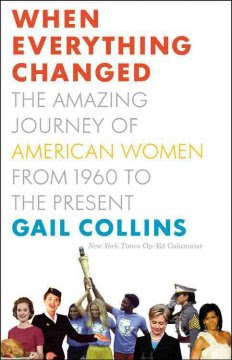 Quite favorably discussed in the 17 December 2009 issue of the New York Review of Books by Cathleen Schine
Friday, October 23, 2009
All the King's Men
 Remake of the 1949 film, updated. Sean Penn plays the upcountry bumpkin who tries to expose corruption, loses an election, and is vindicated by an ensuing tragedy. He is drafted to run for governor some few years later, unaware he is being used a way to split to hick vote. Alerted to the sham, he tosses away his dry speech and let loose with appeals to the pride of the forgotten.
Jude Law is superb as the hard-bitten reporter who joins forces with the reformist politician. Jack Burden also has a romantic link that has never been brought to resolution; that role is played by Kate Winslet, and I thought little of the role or her acting.
Anthony Hopkins plays the thorn in Willie Stark's side. He doesn't quite airmail it in, but his acting seems at least in part done by rote. He's good, sure. Penn is excellent, but it is Law that really shines.
Monday, September 14, 2009
The Stranger
.jpg)
HWPL has an interesting book on Robinson's career, The cinema of Edward G. Robinson.
On the waterfront
Last Wednesday a book review appeared in the Journal about a book entitled On the Irish Waterfront; the 1954 film was discussed. That prompted me to get the film. Watched it Friday night. Quite good: the acting is really good, and not just Brando (who is excellent): Steiger does a very nice job playing the older Malloy brother, a lawyer who works for, and is controlled by, the longshoremen's union; and Lee Cobb does an excellent turn as the bastard corrupt union leader. Eva Marie Saint also does a nice job (her first big screen role; the film credits have it "and introducing").


Wednesday, July 29, 2009
Baseball’s Hall of Fame (and Infamy)
 Cooperstown Confidential: Heroes, Rogues, and the Inside Story of the Baseball Hall of Fame. Zev Chafets.
Illustrated. 237 pages. Bloomsbury. $25.
Took it, started reading it.
Over the years the Baseball Hall of Fame, the shrine in Cooperstown, N.Y., that held its annual induction ceremony on Sunday, has been so fraught with controversies about who deserves admission and who doesn’t that Red Smith, the great sports columnist, once wrote that the only solution was to blow up the place and start over.
In his new book, “Cooperstown Confidential: Heroes, Rogues and the Inside Story of the Baseball Hall of Fame,” Zev Chafets suggests that part of the problem is that the whole institution is built on a foundation of deceit: a falsified creation myth that asserts, all evidence to the contrary, that our national pastime was first played on the bucolic pastures of Cooperstown and that a leathery, rag-stuffed orb bought from a local farmer for $5 might be the game’s Holy Grail, the very first baseball.
I've gotten to that part. Just as absurd as the idea that Abner Doubleday laid out a baseball diamond (something he never spoke of, and that his obituary did not mention) is the idea that that orb was the first baseball. Yet baseball is built, and lives, on myth.
Equally hypocritical is Rule 5 of the hall’s election requirements, the character clause, which specifies that admission should be based not just on a player’s record and ability but also on his integrity, sportsmanship and virtue. This is the bar that has been used to exclude Pete Rose (gambling) and Mark McGwire (performance-enhancing drugs), along with troublesome, mouthy characters like Dave Parker and Dick Allen, and that may eventually be used to banish Barry Bonds, Roger Clemens, Alex Rodriguez and anyone else tainted by accusations of steroid use.
But the brand of moralizing practiced by the Hall of Fame has always been highly selective and inconsistent. At the time of the annual induction ceremony in 2007, Mr. Chafets writes, the hall included “a convicted drug dealer, a reformed cokehead who narrowly beat a lifetime suspension from baseball, a celebrated sex addict, an Elders of Zion conspiracy nut, a pitcher who wrote a book about how he cheated his way into the hall, a well-known and highly arrested drunk driver and a couple of nasty beanball artists.”
That’s just among the living members. The roster of deceased immortals (some inducted before the character clause went into effect) includes Ty Cobb, one of the very first members, famously a sociopath, possibly a murderer and a notorious racist who was also a card-carrying, torch-waving member of the Klu Klux Klan, as were Tris Speaker and Rogers Hornsby. The hall is full of gamblers, brawlers and defendants in paternity suits, and there are numerous drunks, starting with Grover Cleveland Alexander, who Bill Veeck, the colorful baseball executive, once said pitched better drunk than sober.
Doc Ellis once said he pitched a game while tripping on LSD.
Despite its title, though, “Cooperstown Confidential” is not especially gossipy or tabloidy. Most of the dirt Mr. Chafets exposes has been dug up before, and he relies less on new reporting than on other books, especially “The Politics of Glory,” Bill James’s more thorough 1994 history of the hall, and Nicholas Fox Weber’s recent “Clarks of Cooperstown,” a history of the wealthy local family that founded and still controls the Hall of Fame.
The Clarks were something: the grandfather was not just a bigamist, but a trigamist, and, perhaps, even a quadrigamist, who ran off to Europe to avoid the US law; in France he married anew. And the family feuded.
As he readily admits, Mr. Chafets, a former columnist at The Daily News and a frequent contributor to The New York Times Magazine, is not a baseball expert, and it sometimes shows. He says that Jim Bunning pitched one no-hitter when he in fact hurled two, one of them a perfect game.
What shows is awful copyediting. Bunning might be the stupidest man in the Senate, but he did pitch a no-hitter in each league.
Monday, June 29, 2009
American History: 5 best books
An eclectic list
1. The Journals of Lewis and Clark: 1803-05 917.3 (also 978.02)
There are hundreds of books on the Lewis and Clark expedition— scholarly treatises, narratives, biographies, collections of maps. Engrossing reading, sure, but why choose them when the original journals by Meriwether Lewis and William Clark exist? Even if the prose is rough, the journals are an American treasure, a first-hand account of the discovery of a nation. There is a hypnotic, galvanizing power in the daily descriptions of rivers forged, buffaloes seen, Indians met, meals eaten, illnesses suffered, plants examined, rainstorms weathered and dangers overcome. No matter the hardship experienced over the more than two years they spent in the wilds, the two explorers always managed to update their journals, as Lewis did one winter day: “The ink f[r]iezes in my pen,” he complained, before continuing with his account. When Clark writes on Nov. 7, 1805, “Ocian in view! O! the joy,” your heart, too, will leap.
2. The Great Bridge, David McCullough 624.55 M
No other structure better represents American industriousness and ingenuity than the Brooklyn Bridge. In this magisterial account, David McCullough describes its design and construction with all the drama of an epic battle. John A. Roebling, the original engineer of what would be the longest suspension bridge in the world upon its opening in 1883, dies after being injured in a dockside accident as he scouted the construction site. His eldest son, Washington Roebling, takes up the cause, but frequent journeys below the murky East River waters to set the foundations of the bridge’s two massive stone towers leave him crippled with decompression sickness, or “the bends.” His wife, Emily, all but assumes command of the endeavor and sees the project through to its glorious completion.
3. Paul Revere’s Ride, David Hackett Fischer 973.331 F
David Hackett Fischer offers a bracing corrective to the traditional view of the lone silversmith named Revere on horseback alerting Massachusetts patriots with the cry: “The British are coming!” Paul Revere, the author observes, would never have warned of the “British” approach; the colonists still considered themselves British, even if on the cusp of revolution. A minor point, perhaps, but evidence of how legend becomes accepted fact. More important, Fischer shows that though Revere—a “gregarious man, a great joiner”—might have led the alarm-sounding effort, he was far from alone. Dozens of other brave riders set about the countryside on the night of April 18, 1775.
4. The Right Stuff, Tom Wolfe 629.45 W
In Tom Wolfe’s chronicle of Project Mercury and America’s first manned space flight in the early 1960s, we have the perfect marriage of writer and story. With his unblinking eye, Wolfe reveals what constituted the “right stuff”—for test pilots like Chuck Yeager, and, despite the skepticism of some of those flyboys, the seven Mercury astronauts who vied for the chance to perch atop a rocket filled with liquid oxygen and go where no man had gone before. “It was not bravery in the simple sense of being willing to risk your life,” Wolfe writes, because “any fool could do that.” No, “a man should have the ability to go up in a hurtling piece of machinery and put his hide on the line and then have the moxie, the reflexes, the experience, the coolness, to pull it back in the last yawning moment—and then to go up again the next day, and the next day, and every next day.”
5. The Children, David Halberstam 323.1196 H
In a Montgomery bus station on May 20, 1961, a young man got down on his knees and prayed for the strength to love the racist mob closing in on him. “When he tried to get up, someone kicked him violently in the back, so viciously that three vertebrae on his spine were cracked.” This is one visceral scene among scores of others in David Halberstam’s “The Children,” a sweeping portrait of Nashville activists, most of them students, who brought courageous nonviolent protest to the civil-rights struggle in the Deep South. Halberstam covered the movement as a young reporter for the Tennessean, and when he wrote this book four decades later, the memory of those students clearly still burned in his heart.
Mr. Bascomb’s latest book is “Hunting Eichmann: How a Band of Survivors and a Young Spy Agency Chased Down the World’s Most Notorious Nazi” (Houghton Mifflin).
1. The Journals of Lewis and Clark: 1803-05 917.3 (also 978.02)
There are hundreds of books on the Lewis and Clark expedition— scholarly treatises, narratives, biographies, collections of maps. Engrossing reading, sure, but why choose them when the original journals by Meriwether Lewis and William Clark exist? Even if the prose is rough, the journals are an American treasure, a first-hand account of the discovery of a nation. There is a hypnotic, galvanizing power in the daily descriptions of rivers forged, buffaloes seen, Indians met, meals eaten, illnesses suffered, plants examined, rainstorms weathered and dangers overcome. No matter the hardship experienced over the more than two years they spent in the wilds, the two explorers always managed to update their journals, as Lewis did one winter day: “The ink f[r]iezes in my pen,” he complained, before continuing with his account. When Clark writes on Nov. 7, 1805, “Ocian in view! O! the joy,” your heart, too, will leap.
2. The Great Bridge, David McCullough 624.55 M
No other structure better represents American industriousness and ingenuity than the Brooklyn Bridge. In this magisterial account, David McCullough describes its design and construction with all the drama of an epic battle. John A. Roebling, the original engineer of what would be the longest suspension bridge in the world upon its opening in 1883, dies after being injured in a dockside accident as he scouted the construction site. His eldest son, Washington Roebling, takes up the cause, but frequent journeys below the murky East River waters to set the foundations of the bridge’s two massive stone towers leave him crippled with decompression sickness, or “the bends.” His wife, Emily, all but assumes command of the endeavor and sees the project through to its glorious completion.
3. Paul Revere’s Ride, David Hackett Fischer 973.331 F
David Hackett Fischer offers a bracing corrective to the traditional view of the lone silversmith named Revere on horseback alerting Massachusetts patriots with the cry: “The British are coming!” Paul Revere, the author observes, would never have warned of the “British” approach; the colonists still considered themselves British, even if on the cusp of revolution. A minor point, perhaps, but evidence of how legend becomes accepted fact. More important, Fischer shows that though Revere—a “gregarious man, a great joiner”—might have led the alarm-sounding effort, he was far from alone. Dozens of other brave riders set about the countryside on the night of April 18, 1775.
4. The Right Stuff, Tom Wolfe 629.45 W
In Tom Wolfe’s chronicle of Project Mercury and America’s first manned space flight in the early 1960s, we have the perfect marriage of writer and story. With his unblinking eye, Wolfe reveals what constituted the “right stuff”—for test pilots like Chuck Yeager, and, despite the skepticism of some of those flyboys, the seven Mercury astronauts who vied for the chance to perch atop a rocket filled with liquid oxygen and go where no man had gone before. “It was not bravery in the simple sense of being willing to risk your life,” Wolfe writes, because “any fool could do that.” No, “a man should have the ability to go up in a hurtling piece of machinery and put his hide on the line and then have the moxie, the reflexes, the experience, the coolness, to pull it back in the last yawning moment—and then to go up again the next day, and the next day, and every next day.”
5. The Children, David Halberstam 323.1196 H
In a Montgomery bus station on May 20, 1961, a young man got down on his knees and prayed for the strength to love the racist mob closing in on him. “When he tried to get up, someone kicked him violently in the back, so viciously that three vertebrae on his spine were cracked.” This is one visceral scene among scores of others in David Halberstam’s “The Children,” a sweeping portrait of Nashville activists, most of them students, who brought courageous nonviolent protest to the civil-rights struggle in the Deep South. Halberstam covered the movement as a young reporter for the Tennessean, and when he wrote this book four decades later, the memory of those students clearly still burned in his heart.
Mr. Bascomb’s latest book is “Hunting Eichmann: How a Band of Survivors and a Young Spy Agency Chased Down the World’s Most Notorious Nazi” (Houghton Mifflin).
Saturday, June 27, 2009
The state of Jones
The State of Jones
By Sally Jenkins and John Stauffer
Doubleday, 402 pages, $27.50

The idea is beguiling: a region in the South during the Civil War where the inhabitants, disgusted by slavery and unwilling to support the Confederate cause, take up arms as Union loyalists. Better still, for storytelling purposes, would be a charismatic leader who organizes the resistance.
Such is the legend of what became known as the “Free State of Jones,” a county deep in Mississippi’s piney woods. The area was one of many pockets in the state where dissatisfaction with the Confederacy boiled for much of the war, but only Jones County was elevated by folklore, especially in the decades after the war, into a scene of noble rebellion. It helped that the anti-Confederate faction there was led by a tall, stern backwoodsman named Newton Knight.
The operative words here are “legend” and “folklore.” Although Sally Jenkins and John Stauffer labor mightily in “The State of Jones” to make the case for Newt Knight and Jones County as emblems of enlightened “insurrection” within the Confederacy, the truth, alas, is hardly as inspiring as the authors suppose. Far from being a haven for the high-minded, Jones County was a magnet for Confederate deserters. Their hostility to being executed, imprisoned or pressed back into the service of a lost cause was the men’s animating principle.
“As far as the foot soldiers were concerned, the other side could have the damned town. The generals might have gladly given it up too, if not for the railroad junction. ” Read an excerpt from ‘The State of Jones’
It would have helped the authors’ argument if the book were simply better organized—the narrative is often difficult to follow—and if they had been more comfortable with Civil War history. They don’t place the battle of Corinth, or other Mississippi clashes described in the book, within the larger context of the war. Why did these fights happen and why were they important to the wartime fortunes of Mississippi? We’re also left to wonder about Knight’s experience in battle. The authors focus mostly on the “insufferable” day-to-day life of Confederate soldiers.
It wasn’t long, of course, before the bothersome deserters in Jones County became irrelevant to a Rebel army in retreat. Here the book’s interest shifts fully to the life of Newt Knight, during Reconstruction and beyond. As it happened, Knight was married to a white woman but also had a long-running affair with a black woman, even maintaining two separate households. Ms. Jenkins and Mr. Stauffer take this as evidence of Knight’s anti-racist, anti-slavery bona fides, but miscegenation had long been commonplace in the South, even—or especially—among slave owners, who took care of their mixed-blood offspring.
To be sure, Knight went beyond most in his studious maintenance of two households, one white and one black. And the arrangement resulted in many trials for him and his family—his white wife left him, jealousy raged between his two sets of children, and later generations intermarried without regard for their blood links. This is a complicated story, and the authors handle it well; it is easily the most interesting part of the book.
— Michael Ballard, the author of “Vicksburg: The Campaign That Opened the Mississippi,” is the coordinator of the Congressional and Political Research Center at the Mississippi State University Library.
The New York Public Library/Art Resource NY - The Tishomingo Hotel in Corinth, Miss., was used at different times as a hospital by both Union and Rebel troops.

Collection of Herman Welborn - Newton Knight, a Confederate medic and deserter

By Sally Jenkins and John Stauffer
Doubleday, 402 pages, $27.50

The idea is beguiling: a region in the South during the Civil War where the inhabitants, disgusted by slavery and unwilling to support the Confederate cause, take up arms as Union loyalists. Better still, for storytelling purposes, would be a charismatic leader who organizes the resistance.
Such is the legend of what became known as the “Free State of Jones,” a county deep in Mississippi’s piney woods. The area was one of many pockets in the state where dissatisfaction with the Confederacy boiled for much of the war, but only Jones County was elevated by folklore, especially in the decades after the war, into a scene of noble rebellion. It helped that the anti-Confederate faction there was led by a tall, stern backwoodsman named Newton Knight.
The operative words here are “legend” and “folklore.” Although Sally Jenkins and John Stauffer labor mightily in “The State of Jones” to make the case for Newt Knight and Jones County as emblems of enlightened “insurrection” within the Confederacy, the truth, alas, is hardly as inspiring as the authors suppose. Far from being a haven for the high-minded, Jones County was a magnet for Confederate deserters. Their hostility to being executed, imprisoned or pressed back into the service of a lost cause was the men’s animating principle.
“As far as the foot soldiers were concerned, the other side could have the damned town. The generals might have gladly given it up too, if not for the railroad junction. ” Read an excerpt from ‘The State of Jones’
It would have helped the authors’ argument if the book were simply better organized—the narrative is often difficult to follow—and if they had been more comfortable with Civil War history. They don’t place the battle of Corinth, or other Mississippi clashes described in the book, within the larger context of the war. Why did these fights happen and why were they important to the wartime fortunes of Mississippi? We’re also left to wonder about Knight’s experience in battle. The authors focus mostly on the “insufferable” day-to-day life of Confederate soldiers.
It wasn’t long, of course, before the bothersome deserters in Jones County became irrelevant to a Rebel army in retreat. Here the book’s interest shifts fully to the life of Newt Knight, during Reconstruction and beyond. As it happened, Knight was married to a white woman but also had a long-running affair with a black woman, even maintaining two separate households. Ms. Jenkins and Mr. Stauffer take this as evidence of Knight’s anti-racist, anti-slavery bona fides, but miscegenation had long been commonplace in the South, even—or especially—among slave owners, who took care of their mixed-blood offspring.
To be sure, Knight went beyond most in his studious maintenance of two households, one white and one black. And the arrangement resulted in many trials for him and his family—his white wife left him, jealousy raged between his two sets of children, and later generations intermarried without regard for their blood links. This is a complicated story, and the authors handle it well; it is easily the most interesting part of the book.
— Michael Ballard, the author of “Vicksburg: The Campaign That Opened the Mississippi,” is the coordinator of the Congressional and Political Research Center at the Mississippi State University Library.
The New York Public Library/Art Resource NY - The Tishomingo Hotel in Corinth, Miss., was used at different times as a hospital by both Union and Rebel troops.

Collection of Herman Welborn - Newton Knight, a Confederate medic and deserter

Wednesday, June 24, 2009

Friday, June 19, 2009
The Past's Partisans
 The Conservatives
By Patrick Allitt
(Yale, 325 pages, $35)
The slant on the reviewer is immediately available in the review's subtitle: A view wary of government programs—and now out of fashion.
Conservatives, at least modern, self-declared conservatives are not wary of government programs; they simply oppose liberal programs and favor their own.
Has American conservatism run its course? To judge by the pronouncements of scolding liberal pundits -- not to mention of conservatives themselves -- it may even be at death's door. Long ago, the worker-philosopher Eric Hoffer remarked that "all great movements start as a cause, evolve into a business, and end up a racket." While conservatism has gained too much intellectual respectability to be dismissed as a racket, it certainly has its problems.
Indeed it does. One of the problems is confusing conservatism with right-wing ideological purity.
Mr. Allitt does not discover a perfect unanimity of conservative outlook or judgment, of course. But certain principles or concerns persist: limiting power, defending a balanced order, securing property and upholding the rule of law -- not least against radical or anarchic elements.
What a bunch of nonsense: Reagan limited power? Bush? Cheney? Justice Roberts? They sought to consolidate power in the president and run around the check and balances of Congress.
Harrison Gray Otis, a Boston Federalist, warned that those who saw a radical spirit in the clash between the American colonies and British crown mistook the Revolution's nature, for the colonists were acting defensively to protect their constitutional rights.
Excellent point, though one could quibble.
American conservatives in later generations returned to this theme. Nicholas Biddle and Rufus Choate viewed Andrew Jackson in the 1830s as a frontier "Napoleon" and Jacksonian democracy as homespun Jacobinism.
Old Hickory a Jacobin radical?
Southern Conservatives like John Randolph (who denounced "King Numbers" -- majoritarian rule -- in 1830) opposed pure democracy no less than their Northern counterparts. Mr. Allitt shows that what may look like elitism to us, or just plain crankiness, actually reflected a concern with the limits necessary for a stable republican order. The same impulse for order can be seen, he says, in John Marshall's insistence on the judicial review and, decades later, in John C. Calhoun's theory of states' rights, a bulwark, as Calhoun saw it, against the potential despotism of central government.
Calhoun's theory included secession. Given that, perhaps Bob E. Lee and Jefferson Davis can be counted as conservatives. Imagine that.
I would say that Justice Marshall's ruling checked the tyranny of the elite, and strenuously object to his being paired with Calhoun.
During the Depression, conservative politicians found themselves on the defensive, but a backlash against the New Deal eventually laid the foundation for a conservative movement.
Anti-liberalism is the foundation for his conservative movement. They opposed Social Security, engagement in Europe, and unemployment insurance.
Its leaders argued that collectivism assaulted cherished traditions and ignored the concerns of Sumner's "forgotten man."
Who forgot the common folk? Hoover? Hoover.
It was anticommunism -- together with a traditionalist reaction to the social turmoil of the 1960s and 1970s -- that finally gave conservatism a wide base of support. The tenets of the movement included a suspicion of government programs and a faith in the wealth-creating capacities of capitalism. Both seem almost quaint in Barack Obama's America.
Ach, it is the hippies, with their free love and drugs that resulted in Obama.
Monday, June 15, 2009
When the World Tilted--Again

Kaplan, Fred M. 1959: the year that changed everything. (2009). Hoboken, N.J. : J. Wiley & Sons.
It was the year, as Mr. Kaplan's handy timeline reminds us, that Fidel Castro took power in Cuba, Berry Gordy started Motown records in Detroit, Allen Ginsberg recited "Howl" at Columbia, the Pioneer spacecraft blasted off, the dirtiest version of "Lady Chatterley's Lover" was published, Toyota and Datsun (now Nissan) made their American debuts and Ford mercy-killed the Edsel, the microchip was introduced, the first U.S. soldiers were killed in Vietnam, Frank Lloyd Wright's Guggenheim Museum opened, Martin Luther King went to India to study nonviolence, Jasper Johns and Robert Rauschenberg were shown at the Museum of Modern Art, and Searle sought approval to sell the first birth-control pill, Enovid. In sum, a year "when the world as we now know it began to take form."
Some of Mr. Kaplan's strongest chapters deal with the evolution of Dr. King and the man who seemed to some his evil twin, Malcolm X, the Black Muslim apostate, and the civil-rights rebellion that gained momentum after the first lunch-counter sit-in in Greensboro, N.C., a month into the 1960s. The author gives credit to the now all-but-forgotten September 1959 report of the U.S. Civil Rights Commission, a chart-laden, 668 pages that meticulously documented the scope of racial discrimination in America. Southern senators immediately tried to kill the commission. "Isn't a segregated life the proper life?" asked Mississippi's Jim Eastland. "Isn't it the law of nature?"
Friday, March 13, 2009
The woman behind the New Deal
 Downey, Kirstin. (2009). The woman behind the New Deal : the life of Frances Perkins, FDR's Secretary of Labor and his moral conscience. New York: Nan A. Talese
Other than the name, I knew nothing about Frances Perkins. Now I know a great deal. She became interested in social work very early in her life, worked with Hull House in Chicago (with Jane Addams), and wound up in New York. The day of the Triangle Shirtwaist factory fire she was in a friend's house on Washington Square North, and ran to the location of the fire (on Washington Square East -- I actually took an NYU course in a building in that same location).
FP met FDR early on in New York government. She knew Robert Moses before he worked in State government. She knew Al Smith. When FDR won the Presidency, he appointed her Labor Secretary, the first woman to ever serve in the Cabinet. She accomplished a great deal, indeed.
The book contends that Social Security, Unemployment insurance and others New Deal programs were her ideas that FDR adopted. I have never read about that before. The book also contends that when FDR told Cabinet member of the Pearl Harbor attack, FP suspected that he had known about it, for he did not show the same surprise and shock that other Cabinet members showed.
Revealing, sympathetic, the book does a good job of uncovering a forgotten figure who played an important role in 20th century America. Indeed, the world: she was instrumental in saving LIO people from Europe, and got Churchill and FDR to support it after the War.
In her personal life, FP was quite unlucky. Both her husband and her daughter were bipolar, in an age when there were no medicines to effectively deal with the illness. She did make friends, close personal friends with several women. Mary Harriman Rumsey, older sister of Averell, in particular, was very close friends with FP. They shared a house for some time.
Yet about halfway through, the book gets sloppy in its assertions. I'd like to see more documentation on some of the declarations made.
And then there is the Venona Project.
"The Americans and British long had been skeptical about Soviet intentions. As a result, between 1942 and 1945, the United States and Great Britain engaged in the Venona Project, intercepting encrypted cables between Russian intelligence agencies and Soviet spies based in America. They began successfully decrypting these messages in 1946. National security officials kept the information secret, but released some facts through the FBI, and through that agency to Truman.The deciphered messages exposed several hundred Americans, including some government officials, as communist spies."
Tuesday, November 4, 2008
April 4, 1968
April 4, 1968 : Martin Luther King, Jr.'s death and how it changed America (2008)
Dyson, Michael Eric. New York: Basic Civitas Books.

323.092 D
Dyson, Michael Eric. New York: Basic Civitas Books.
323.092 D
Subscribe to:
Posts (Atom)